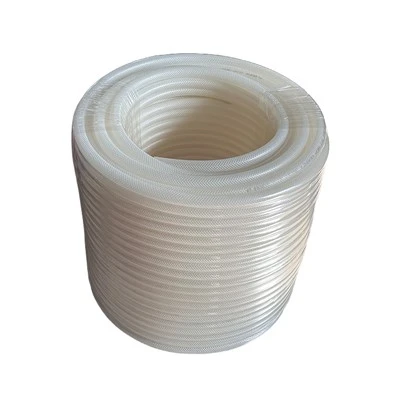

Hey there! As a TPE tubing supplier, I often get asked about how our products perform in high - temperature environments. Well, let's dive right in and take a closer look at this important topic.
First off, what's TPE tubing anyway? TPE stands for Thermoplastic Elastomer. It's a really cool material that combines the best of both plastics and rubbers. It's flexible like rubber, but can be processed like plastic. That makes it super versatile for all sorts of applications, from automotive to medical.
Now, when it comes to high - temperature environments, TPE tubing has some unique characteristics. One of the key factors is its heat resistance. Different types of TPE tubing have different levels of heat resistance, which is usually measured in terms of the maximum continuous use temperature.
For example, some of our TPE tubing can handle continuous use temperatures up to around 80 - 100°C (176 - 212°F). This makes it suitable for a lot of industrial applications where there's some heat involved, but not extreme heat. In these cases, the tubing maintains its flexibility and durability. It doesn't become brittle or start to break down easily, which is a huge plus.
Let's talk about the structure of TPE tubing and how that affects its high - temperature performance. TPE tubing is made up of polymer chains. At normal temperatures, these chains are all tangled up, which gives the tubing its flexibility. But when exposed to high temperatures, the chains start to move around more freely.
If the temperature is within the tubing's heat - resistant range, the chains can move enough to maintain some flexibility, but not so much that the tubing loses its shape. However, if the temperature goes beyond its limit, the chains can start to break apart. That's when you might see the tubing start to melt, deform, or lose its mechanical properties.
In high - temperature environments, another thing to consider is the chemical stability of TPE tubing. Some chemicals can react with the TPE material at high temperatures, which can lead to degradation. For example, strong acids or bases might cause the tubing to become weaker over time. But don't worry! Our TPE tubing is formulated to be chemically resistant to a wide range of substances, even at elevated temperatures.


Let's take a look at some real - world applications. In the automotive industry, TPE tubing is used for things like coolant lines. The engine gets really hot, and the coolant needs to be circulated through the system. Our TPE Hose can withstand the high temperatures and pressures in the engine compartment without leaking or failing. Similarly, in the manufacturing industry, for processes that involve hot fluids, our Thermoplastic Elastomer Hose is a great choice.
In the medical field, TPE Medical Tubing might be used in devices that need to be sterilized at high temperatures. Our tubing can handle the heat from the sterilization process without losing its biocompatibility or flexibility, which is crucial for patient safety.
Another example is in the water supply industry. TPE Water Hose can be used in areas where the water might be warm, like in some industrial cooling systems or in hot water distribution networks. The tubing can handle the heat and still provide a reliable water flow without any issues.
When it comes to high - pressure applications at high temperatures, our TPE Sand - Reinforced Hose is pretty awesome. The sand reinforcement provides extra strength and stability, allowing the hose to maintain its shape and integrity even under high pressure and heat.
If you're considering using TPE tubing in a high - temperature environment, here are a few tips. First, always check the technical specifications of the tubing to make sure it's suitable for the temperature range you need. Second, think about any chemicals or substances that the tubing will come into contact with. Make sure the tubing is resistant to them at the expected temperatures.
We understand that every application is unique, and that's why we offer a wide range of TPE tubing products with different heat - resistant properties. Whether you need a tubing that can handle a little bit of heat or one that can withstand extreme temperatures, we've got you covered.
If you're in the market for TPE tubing for high - temperature applications, don't hesitate to reach out to us. We're here to help you find the perfect solution for your needs. Whether you're a small business or a large corporation, we can provide you with high - quality TPE tubing and excellent customer service.
When you contact us, we can discuss your specific requirements in detail. We can help you choose the right type of tubing, thickness, and other specifications to ensure that it performs perfectly in your high - temperature environment. Plus, we offer competitive pricing and fast delivery to get your project up and running as soon as possible. So, what are you waiting for? Let's start a conversation about your TPE tubing needs.
References
- Smith, J. (2020). Thermoplastic Elastomers: Properties and Applications. Journal of Polymer Science.
- Johnson, A. (2019). High - Temperature Performance of TPE Materials. Industrial Materials Review.